
Some initial thoughts on the National Food Security Strategy released today

Today the PM announced the National Food Security Strategy. You can read the full meal deal (pun intended!!) here: https://agriculture.canada.ca/en/department/initiatives/national-food-security-strategy or the PMO summary here: https://www.pm.gc.ca/en/news/news-releases/2026/06/11/prime-minister-carney-launches-national-food-security-strategy
The diagnostique at the front end of the full document is worth your time. Weak retail market competition, limited processing capacity (especially relative to our production capacity), and heavy reliance on imported foods are all big parts of the problem on top of input costs (where, let’s be clear, carbon pricing is just not an important driver).
Let’s stick with the reliance on imported foods for a second. This table is something I pulled together last year using national trade data (for 2023, the most recent complete year at the time). And it’s not just that we import a lot of our groceries, it’s also who we import it from.
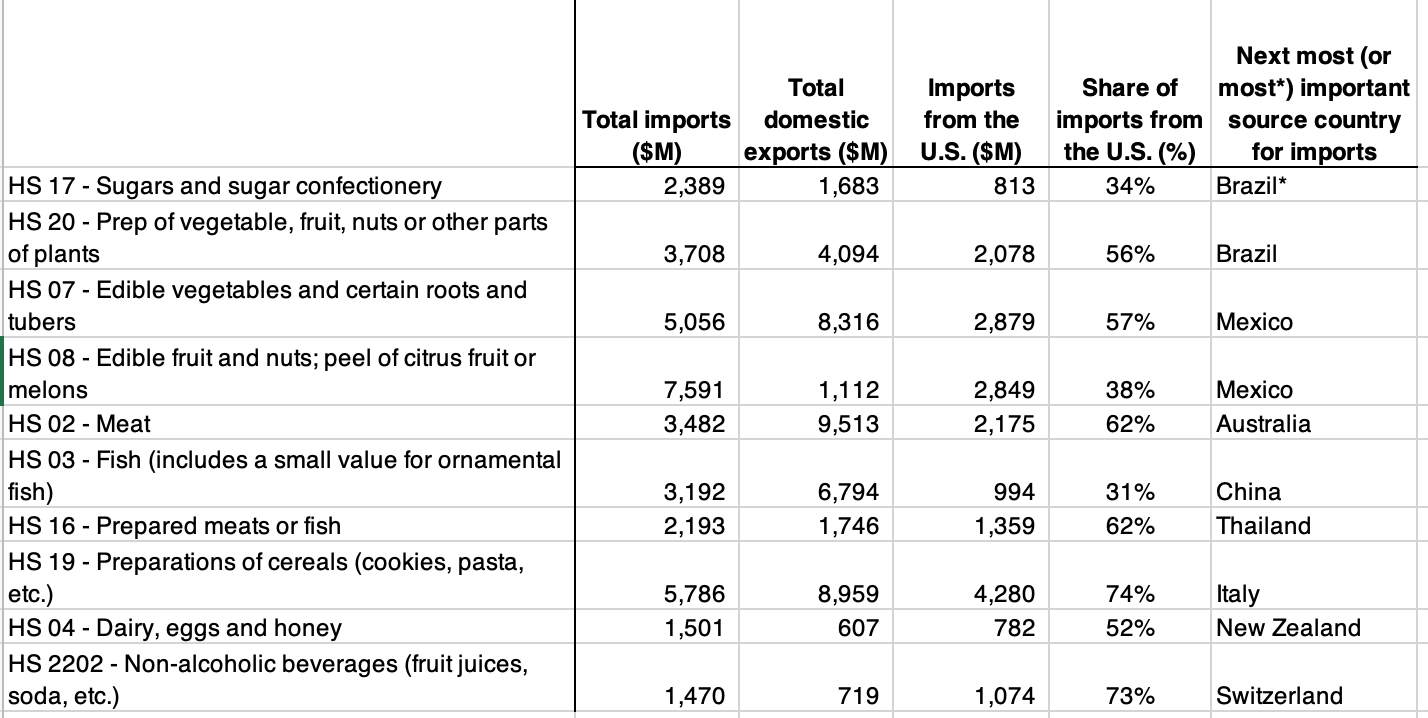
So long as the U.S. continues to make their own food production and distribution more expensive by deporting important shares of the farm labour pool, making it more difficult to obtain key fertilizers and then tariffing some even when they have a secure supply, or by dramatically reducing the capacity of the U.S. Department of Agriculture, some of that cost will be passed along to Canada.
So, a strategy to boost national food sovereignty makes some good sense to me. I like the general direction on some key supply-side .
There’s a focus on expanding domestic food processing capacity. Yes please! My estimate is that we produce about 200 tonnes of wheat for every tonne that we process into something you could actually eat or turn into something edible.
There’s a focus on expanding year-round production of fruits and vegetables, both in quantity and diversity of products. Yes please! And if you would like to invest in my proposed indoor citrus grove (with a side hustle in year-round companion mange-tout peas and cut flowers) business, call me!
And there’s a focus on building on the capacity of Farm Credit Canada to “catalyze” (the PM’s favorite word, not mine), innovation in Canadian agriculture — something we’ll need to navigate climate change, geopolitical instability and just to maintain our comparative advantage. Again, yes please!
As always, dear reader, you know my niche: nit-picky policy questions about how to turn ambitious announcement into practical and feasible delivery. And there are some.
Who will benefit from the $750 million for the Controlled Environment Agriculture Growth Pathway? Ag&Ag pays a lot of attention to size and capacity of production, but they don’t seem to track ownership. Much of Canada’s existing greenhouse infrastructure has been a very affordable acquisition for U.S. buyers. Will any foreign ownership rules apply if it is true (and I think it is) that, as the PM’s release stated “[a] country’s sovereignty depends on its ability to feed itself, fuel itself, and defend itself.”
Who will step up to be the project proponents of plan to expand the number of food terminals? The one big one we have, the Ontario Food Terminal is actually run by a provincial crown corporation, the Ontario Food Terminal Board. It does make a bit of money, $1.7 million last year, but is that a proof of possibility that other provinces (BC? Quebec? New Brunswick?) would be willing to latch onto? Would we be open to a private sector operator? If so, why should government be subsidizing their capital expenses without a public stake?
On food processing, one of the big challenges for expanded capacity is the skilled labour supply. The strategy today offered $400 million in new funding to bolster food processing capacity in Canada, on top of existing funding ($500 million). But the mentions of labour pointed back to the red seal trades announcement in the Spring Economic Update. If only the Government of Canada had invested in a body that had tried and tested scaleable approaches to workforce strategies specific to the food and beverage processing sector that it could again turn to as a complementary measure….
Finally, I bet there will be many who are disappointed by the supply-side approach in this strategy. The document does nod to and re-announce the School Food Program and the Groceries and Essentials Benefit (formerly known as the GST Credit). But there isn’t new money for demand-side in this national plan. It’s not that new Benefit and the School Food Program aren’t important. But tackling immediate, moderate and severe food insecurity (while we wait for long-term change to food production, processing and distribution to improve, which may or may not actually reach those at risk of food insecurity) would require a benefit worth a lot more than the current GEB. More on that at a later date.